Almost every kid who collects trading cards eventually draws their own. The first homemade card is always the same: a monster with 9,999 attack, every power at once, and a name with "Ultra" in it. It's a great drawing, and it breaks the game the moment it hits the table, because nobody can beat it.
That's the most useful moment to start designing. Making a card game is mostly about one question: how do you make every card strong, but not too strong? Here's a simple method, the same one behind our book Make Your Own Monster Trading Cards. You don't need the book to use it: paper, a pencil and scissors are enough.
Step 1: a monster, a picture and a name
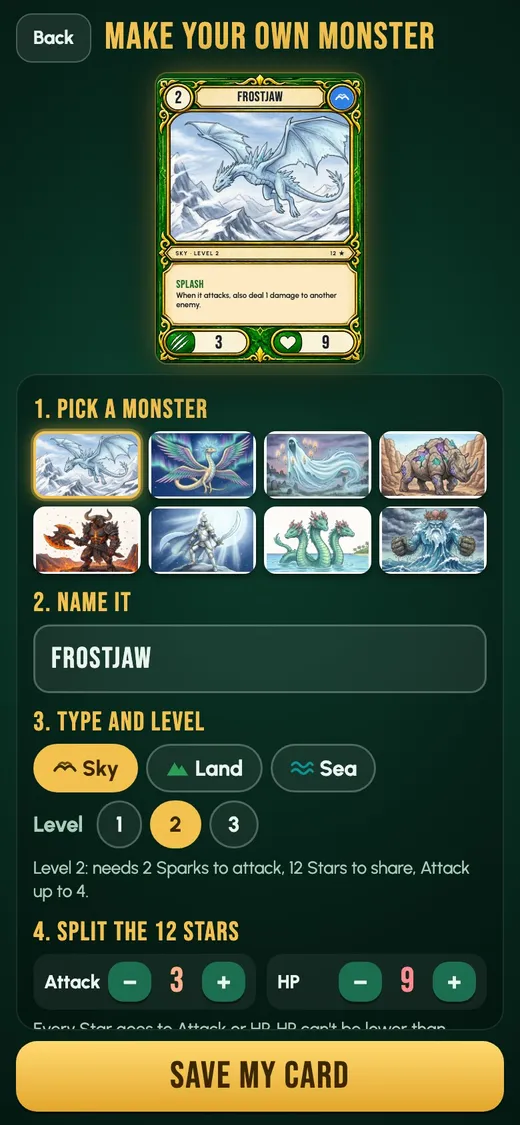
Every card starts as a monster with a picture and a name. Cut cards to the standard trading-card size, 63 x 88 mm (2.5 x 3.5 inches), so they fit ordinary card sleeves. Keep names short: one or two words are easy to remember and easy to say at the table. A good trick for names is to join two words: Frost + jaw = Frostjaw.
Can't draw? That's fine. Draw a simple shape (a circle, a bean, a triangle), then add wings, fins or horns. Or use the free card maker, where the monsters are already drawn. For paper cards, Monster Card Clash has free printable card templates in seven designs, plus 24 ready monsters to play with.
Step 2: two numbers, Attack and HP
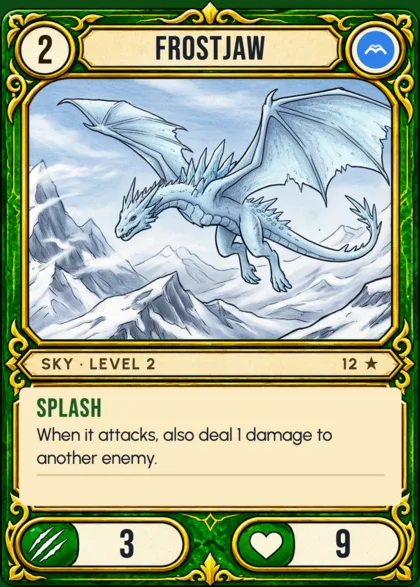
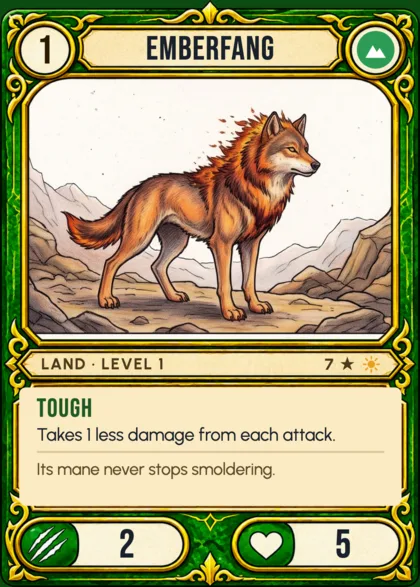
Give each monster an Attack (the damage it deals) and HP (the damage it can take before it's knocked out). Usually HP should be higher than Attack, so a monster survives the first hit and the other player can answer back. A Level 1 monster with Attack 2 and HP 5 is a good start.
Step 3: Levels and Stars, the rule that keeps it fair
Here's the rule that stops the 9,999-attack monster. Every monster has a Level, and every Level gets a fixed number of Stars to split between Attack and HP, with a limit on Attack:
| Level | Stars to split | Attack up to | Example |
|---|---|---|---|
| Level 1 | 7 | 2 | Attack 2, HP 5 |
| Level 2 | 12 | 4 | Attack 4, HP 8 |
| Level 3 | 20 | 8 | Attack 8, HP 12 |
 Level 1 · 7 ★Attack 2 + HP 5
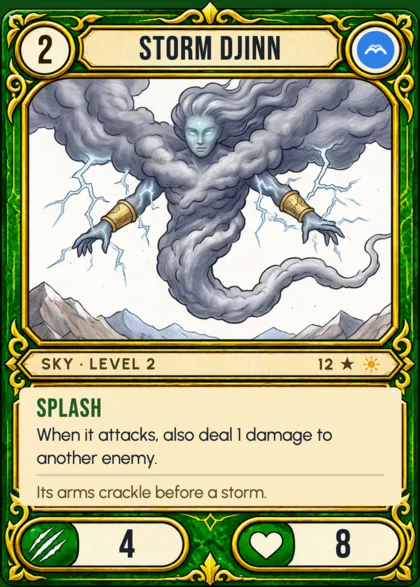 Level 2 · 12 ★Attack 4 + HP 8
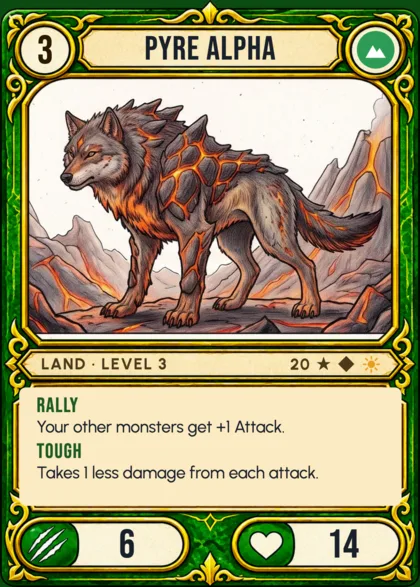 Level 3 · 20 ★Attack 6 + HP 14
Big monsters need a cost, or everyone would only play big monsters. In our game the cost is time: a monster needs as many Sparks (energy) as its Level before it can attack, and you get one Spark per turn. A Level 3 monster hits twice as hard as a Level 1, because you waited three turns for it.
Step 4: types that beat each other
Types give players choices. Use three that beat each other in a circle, like rock, paper, scissors: in our game, Sky beats Sea, Sea beats Land, and Land beats Sky, for +2 damage. Now there's no single best monster: every monster is strong against one type and weak against another, so a mixed deck matters.
Step 5: one ability per monster
An ability is a monster's special move, written in one short sentence. Bigger monsters can have bigger abilities. A few that work well:
- Tough (Level 1+): takes 1 less damage from each attack.
- Guard (Level 2+): enemies can only attack your Guard monsters.
- Splash (Level 2+): when it attacks, also deal 1 damage to another enemy.
- Double Strike (Level 3+): attacks twice, hitting 2 different monsters.
ToughLevel 1+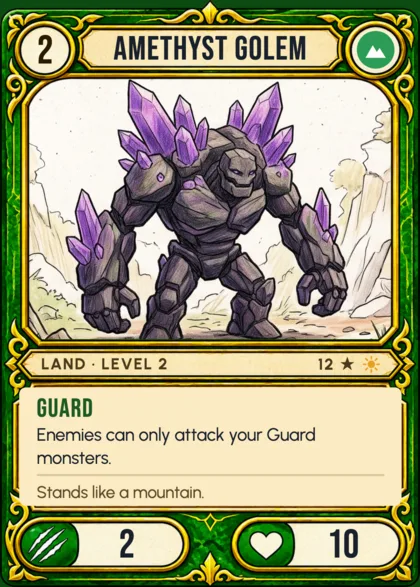 GuardLevel 2+SplashLevel 2+
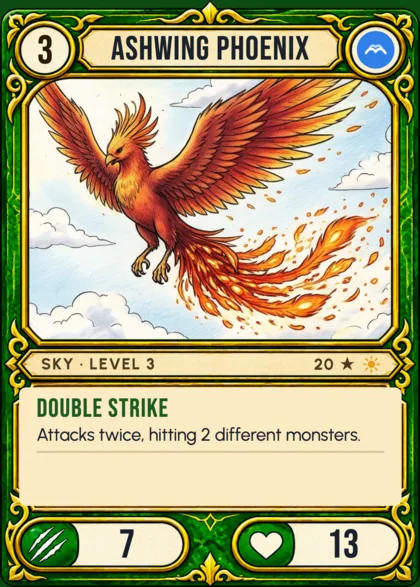 Double StrikeLevel 3+
The golden rule for inventing abilities: free extras are never small. An ability that gives a monster a free extra attack or free energy is much stronger than it looks. Keep new abilities small, play a few games, and make them weaker if they win every time.
Step 6: build a deck and play the coin test
Make a deck of 20 cards: two copies of each monster, with a mix of Levels and types. Then play your deck against a friend's deck six times and write down who wins. A fair game is like tossing a coin: 3–3 or 4–2 means balanced; 5–1 or 6–0 means something is too strong. Change one card at a time, then test again. That's exactly how real game designers work.
What you need
- Thin card or paper, cut to 63 x 88 mm, or a free printable blank card sheet
- A pencil and colored pencils
- Small tokens to count damage and energy (coins or paper squares)
- Card sleeves with an old playing card behind each card, if you want them to shuffle like real cards
Frequently asked questions
What age can kids make their own trading card game?
From about 8, kids can make their own cards with the Stars rule. Inventing new abilities and testing decks works best from about 10, or with a grown-up to play against.
How do you make homemade cards fair?
Give every Level a fixed number of Stars to split between Attack and HP, cap Attack, and make big monsters cost more time. Then play the coin test and change one card at a time.
Can we use our homemade cards with other card games?
It's best to play them in your own game. Every card game balances its numbers differently, so homemade cards are fairest against other homemade cards made with the same rules.